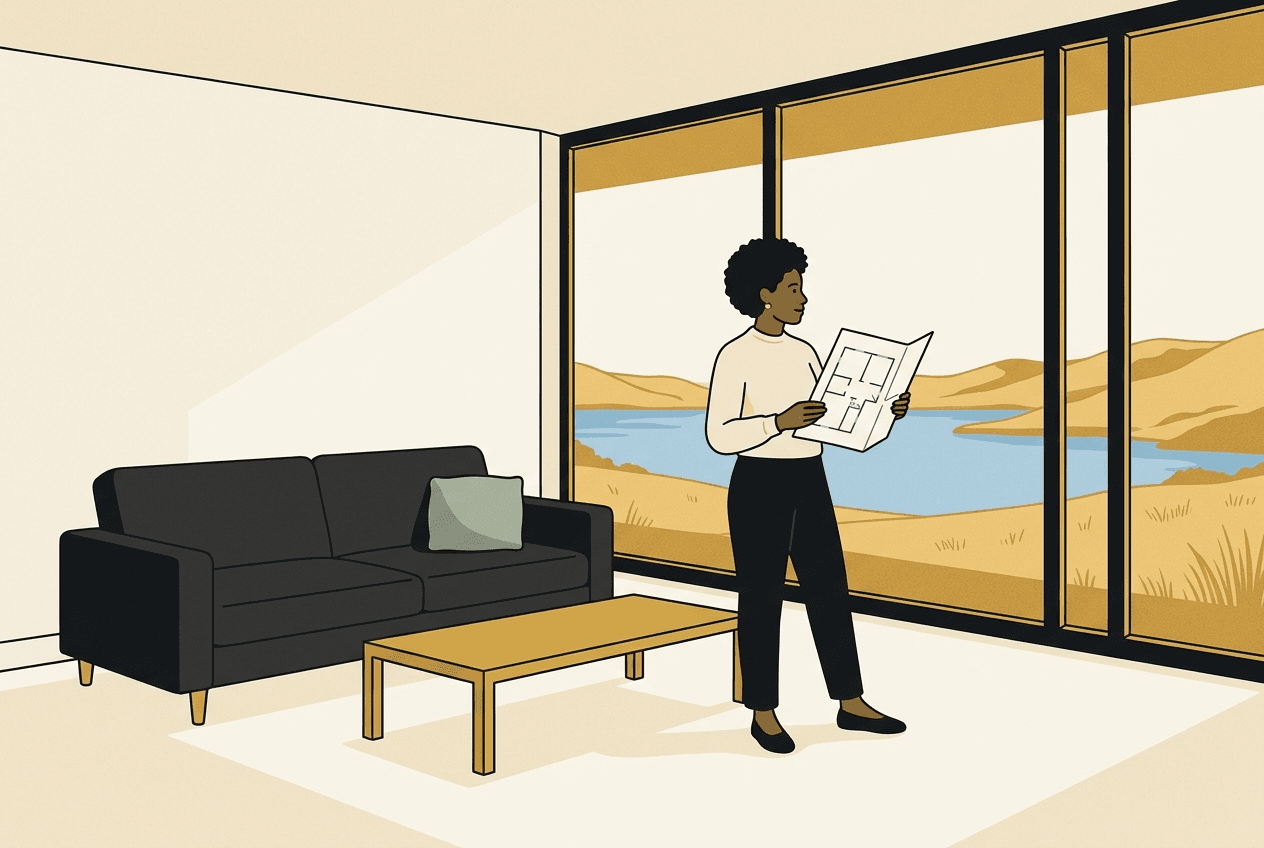
You have sold the family home. The condo is smaller, maybe half the storage you have now, and you are standing in a garage or a spare room trying to work out where to start.
Most people start by picking things up one at a time and asking, do I keep this. That is the slowest possible way to do it. You are exhausted by noon and the pile has barely moved, because every single object has been turned into its own separate decision.
Start somewhere else. Start with the condo.
Measure the new place before you touch the old one
Get the floor plan. Most condo listings and builders have one with dimensions on it. If you can, walk the unit with a tape measure before you move, and take photographs of the inside of every closet.
Then write down what you actually have to work with. Linear feet of closet rod. Number of kitchen cabinets and their depth. Whether there is a storage locker, where it is, and how big. Whether the second bedroom is a real bedroom or a room that fits a bed and nothing else. Whether the balcony is somewhere you can keep anything through a Kelowna winter, which it usually is not.
Now you have numbers. The new place holds what it holds. Two hall closets, not five. One linen shelf, not a whole cupboard. This part carries no feeling at all. It is arithmetic.
Most right-sizing advice misses this, because it treats what fits and what to keep as the same question. They are two different questions and they deserve different days. What fits is measurable. You can stand in the condo kitchen and know that eight mugs fit the shelf and forty do not. What to keep is harder, and it deserves the energy you still have left once the easy maths is out of the way.
So do the maths first. When you know the kitchen holds one set of everyday dishes and one small stack of serving pieces, the question in front of you changes shape. You are no longer asking whether you love this platter. You are asking which four of your nine platters earn the four spots. That is a question a person can actually answer on a Tuesday.
Sort against the space, one category at a time
Work one category at a time, and hold each one up against the number you wrote down.
Kitchens are the easiest place to begin because the limits are obvious and nobody cries over a colander. The new cabinets hold what they hold. Pull everything out, keep what fits the new kitchen plus the pieces you genuinely use, and the rest moves on.
Closets are harder, because clothes carry more feeling than cookware. The rod length is still a fixed number though. If the new bedroom has six feet of hanging space and you currently use fifteen, that gap gets decided one way or another. Better that you decide it in your own time than that a moving box decides it for you at eleven at night.
Books, tools, holiday bins, the good china nobody has eaten off since 2009. Same approach every time. What does the new space hold, and what earns that space.
The order that makes this survivable
A few things are worth saying plainly, because they are the difference between a move that goes well and one people are still recovering from at Christmas.
You do not have to decide the hardest items first. Photo albums, your parents' things, anything with real weight to it can wait. Clear the easy volume first so you can see what you are dealing with. Momentum is worth more than heroism here.
Small sessions hold. A weekend blitz where you empty the whole house does not, because you make forty decisions an hour and a good half of them are wrong. I would rather see four short sessions across three weeks than one brutal Saturday you spend the next month regretting.
You will disagree with each other. One of you is ready to let the dining set go and the other is nowhere near it. That is normal and it is not a problem to be solved by whoever is more tired. The set does not move until you both agree, and there is no schedule I could put on that decision that would be worth putting on it.
And give yourself more time than the possession date suggests. In the Okanagan, right-sizing usually happens in a hurry because a condo came up or a house sold quickly, and the sorting gets squeezed into the last three weeks. If you can begin two months out, even in ninety-minute pieces, the whole thing changes character.
What happens to everything that does not fit
This is where right-sizing in the Okanagan gets practical, because a great deal of what you clear still has real value.
Furniture that does not suit the condo. Tools you will not use in a building with no garage. The second set of everything you have owned since the kids were small. Patio furniture sized for a yard. A chest freezer. The dining table that seats ten.
If this move is happening because a parent has died rather than because you chose it, the sorting is a different job with different weight in it, and I have written about what an estate clear out actually involves.
I price and list those items while I am in your home with you, mostly on Facebook Marketplace and other local platforms. That is how the resale service works. I handle the listings and the inquiries. When there is a confirmed buyer, I connect them to you, and you handle the pickup and take the payment directly. Your things never leave your house until they sell, and you keep 60 percent of every sale. Whatever is genuinely done gets hauled away as part of the project through my removal partner, so there is no dump run in your last week.
What that changes is the shape of the whole move. The gap between the big house and the small condo stops being purely a cost. Some of it comes back, and on a full house it can come back to a meaningful degree.
What people regret, and what they do not
I have been through this with enough Okanagan families to notice a pattern in what gets said six months later.
Almost nobody regrets the volume they let go of. What people regret is a specific, small number of things they released in a rush at the very end, usually on the last night, usually because the truck was coming and a decision had to be made in ninety seconds. That is exactly the situation that starting early prevents.
The other regret is furniture kept out of loyalty. A dining set that does not fit, held onto because it was a wedding gift, that then lives in a storage locker at two hundred dollars a month for three years. That is not keeping something. That is paying rent on a feeling. If a piece genuinely matters, give it a place in the new home or give it to somebody in the family who will use it, and let the rest go while it still has value to somebody else.
What nobody regrets, ever, is arriving in a smaller place where everything has a spot on day one. That is the actual goal here. The point of a smaller home is that it is easier to live in, and it only becomes easier if what came with you fits.
The things the kids might want
Every right-sizing job reaches a point where somebody says, the kids might want this.
Sometimes they do. More often what happens is that the piece travels to the new place, or into a locker, on the strength of a maybe that nobody has ever actually asked out loud. Three years later it is still there and the maybe has never been resolved.
Ask them. Directly, with photographs, with a date attached. Send a picture of the hutch and say the move is in six weeks and it needs an answer by the end of the month. Most adult children in their thirties are living somewhere smaller than you are moving to, and the honest answer is usually no. That is not a rejection of the family. It is a bungalow in Rutland with one closet.
What you must not do is decide on their behalf in either direction. Do not quietly get rid of something they have asked for, and do not haul something across town for somebody who never wanted it. Photograph, ask, set a date, act on the answer.
One thing to do this week
Find the floor plan for the new place and write down the real storage it has. Closets, cabinets, the locker, and the honest depth of each one. Take twenty minutes over it.
Once you have those numbers on paper, the rest of it stops being a mountain and starts being a list. A list is something you can work through in pieces. A mountain is something you stand at the bottom of.
When you want a hand with the list, the consultation is free and there is nothing to prepare for it. Text me at 250-718-4227 and we will walk the house together, work out the scope, and set a pace that will not flatten you. No judgement. I got you.