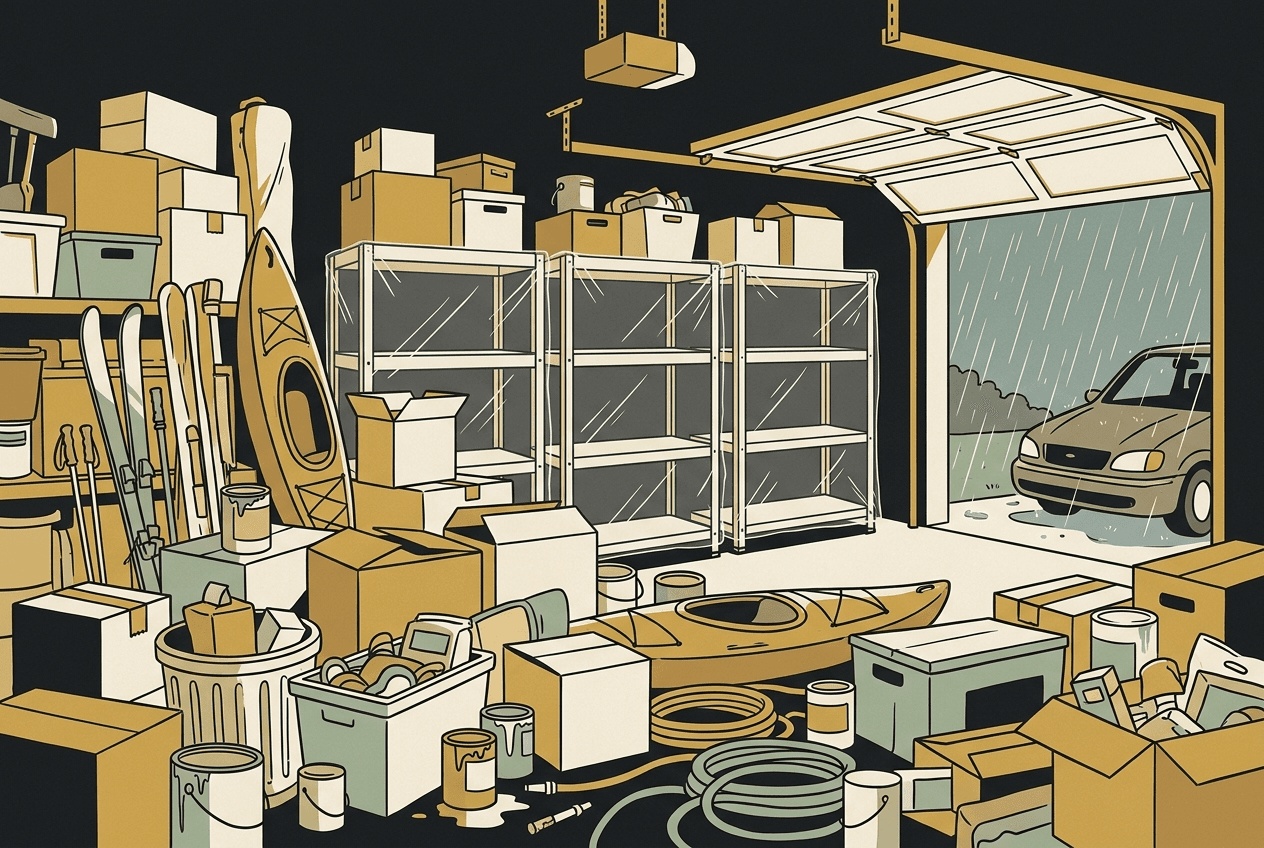
Almost every garage call I get in Kelowna opens the same way. The car has not been inside for three years, and the person on the phone has already decided the answer is shelving.
It usually is not shelving.
More shelving on the wall of a full garage moves the pile up to eye level. The floor stays where it was, the room still feels heavy, and now the pile is the first thing you see when you pull into the driveway. You have spent a Saturday and a few hundred dollars relocating the problem three feet higher.
I have worked in a lot of Okanagan garages. Kelowna, West Kelowna, Peachland, Lake Country, up toward Vernon. They fill up in the same two ways, and neither one is a storage shortage. Garage organization in Kelowna has less to do with square footage than almost anyone expects.
What a full garage is actually short of
Storage is rarely the constraint. Decisions are.
Walk any full garage and you will find the same categories. Things that belong to a house you no longer live in. Things that belong to a hobby you stopped in 2014. Things that are broken and were going to be fixed. Things that belong to adult children who have their own places now. Paint. Everybody has the paint.
If the same thing has happened to a room inside the house, that is a slightly different problem with a related answer, and I wrote about the spare room that fills up before company comes separately.
None of that is a storage problem. Every one of those categories is a decision nobody has made, sitting in a cardboard box, holding floor space while it waits.
Shelving lets you put the decision off for another two years, and that is honestly the appeal. Buying a rack feels like progress and costs you nothing emotionally. Deciding the table saw is never coming back is the hard part, and no amount of steel changes it.
So when someone asks me which shelving to buy, I tell them to buy it last. You cannot size storage for a space until you know what is staying in it. Nine times out of ten it is less than they were about to spend on.
Start on the floor, not the walls
The first thing I do in a garage is clear a landing zone on the driveway, and then we empty a section onto it.
Not the whole garage. A section. One wall, or one corner, or everything within six feet of the side door. Emptying an entire garage onto a driveway in July sounds decisive and it is a trap, because you run out of daylight, you get tired, and the fastest way to get it all back inside is to put it back exactly as it was.
With a section on the ground you can see it properly. Things that were stacked three deep for years turn out to be two bikes with flat tires and a box of extension cords. It is the same way I start any home organizing job, and it works in a garage for the same reason it works in a pantry. You cannot decide about what you cannot see.
Only once the floor is visible do we talk about what goes on the walls, and by then the answer is obvious, because the amount left over is a known quantity instead of a guess.
An Okanagan garage is holding two seasons at once
This is the part that is specific to here, and it is why garage advice written for somewhere with a mild winter does not survive contact with a Kelowna driveway.
Your garage carries two full lives. Skis, poles, boots, a snowblower, winter tires, the shovels. Then paddleboards, patio cushions, bikes, camp chairs, the cooler, the hose. Both sets are real, both get used, and both want the same square footage. Twice a year the whole room has to change over, and most people do the change over by moving the front pile to the back and calling it done.
The result is a garage where nothing is truly put away and nothing is truly accessible. In April you are climbing over the snowblower to reach the paddleboard. In November you are moving the paddleboard to reach the snowblower.
A bigger garage does not fix that. Neither does more shelving, because the volume was never the issue. Most garage organization advice is written for a climate with one season and it falls apart here in the second week of April. Two seasons in one room is a scheduling problem wearing a storage problem's clothes.
Give the front row to the season you are in
Here is the rule I use, and it survives contact with real families.
One season gets the front. Everything from that season lives between knee and shoulder height, within one step of where you walk. The other season goes high, goes deep, or goes on the wall where you have to fetch a ladder to reach it, and that is fine, because you only touch it twice a year.
Then you write the change over down. Two lines on a piece of paper taped inside the door. What comes forward in April, what comes forward in October. It takes about forty minutes each time when there is a list, and most of a weekend when there is not, because without a list you re-decide everything from scratch every six months.
That single decision does more for an Okanagan garage than any shelving unit I have ever installed. It also survives the winter, which is the part that matters. A system that works in June and collapses in December was never a system.
The four groups everything falls into
When we sort a garage section, everything lands in one of four places, and I say the four out loud as we go so nobody has to hold them in their head.
Stays. It is used, it belongs to this house, it belongs to a season you still participate in.
Sells. This group is bigger in a garage than anywhere else in the house. Tools, lawn equipment, bikes, camping gear, sporting goods, ladders, roof boxes. Garages are where the expensive stuff goes to be forgotten about.
Donates. Still useful, not worth the effort of listing. Somebody in Kelowna will take it this month.
Goes. Broken, seized, mouldy, or a half can of deck stain from 2011. I arrange removal as part of a project through my junk hauling partner, so you are never the one making a dump run on a Sunday.
The reason four groups work is that they turn a very large question into a very small one. You are not deciding what to do with your garage. You are deciding which of four places one object goes, and then the next object, and then the next.
What is genuinely worth selling out of a garage
People underestimate this every single time, and a garage is the room where they underestimate it most.
Cordless tool sets hold their value. So do good hand tools, table saws, compressors, generators, pressure washers, roof racks, hitch carriers, canoes, kayaks, paddleboards, decent bikes, and almost anything with a recognisable brand on it that still runs. What does not sell well out of a garage is old paint, particle board shelving, exercise equipment, and anything with a small engine that has been sitting with fuel in it since 2019.
When I find the sellable items during a sort, I price them and list them with you, right from your home, usually on Facebook Marketplace. Your things never leave the property until there is a confirmed buyer, and you handle the handoff and take the payment directly. You keep 60 percent of every sale. On a full garage that money is real, and it very often covers a good part of what the job cost in the first place.
What a garage actually costs to do
A two car garage that has never been sorted is usually two sessions, sometimes three if there is a workshop in it or if the family is dividing a parent's tools between siblings.
Organizing is forty-five dollars an hour with a three-hour minimum, so you can do the arithmetic on that before you call anybody. I would rather you know the number up front than find it out on an invoice. If the resale side goes well, a chunk of it comes back.
One more thing worth saying, because people apologise to me about their garages more than any other room. I do not care what it looks like. I have opened doors on garages nobody had walked into in six years. There is no version of this where I think less of you. A garage fills up because life happened in a particular order, and that is all.
One corner, this weekend
Do not do the garage. Do one corner of it.
Pick the corner nearest the door you use most. Take everything out of it, sort it into the four groups out loud, and put back only what belongs to the season you are in right now. Give yourself ninety minutes and stop when the time is up, finished or not.
What you will notice is not the tidy corner. It is how much of what came out of it was a decision from years ago that you have been walking around ever since.
When the rest of it feels like more than you want to take on alone, that is the work I do. Book a free consultation and I will walk the space with you, tell you honestly how many sessions it needs, and we will start on the floor. No judgement. I got you.