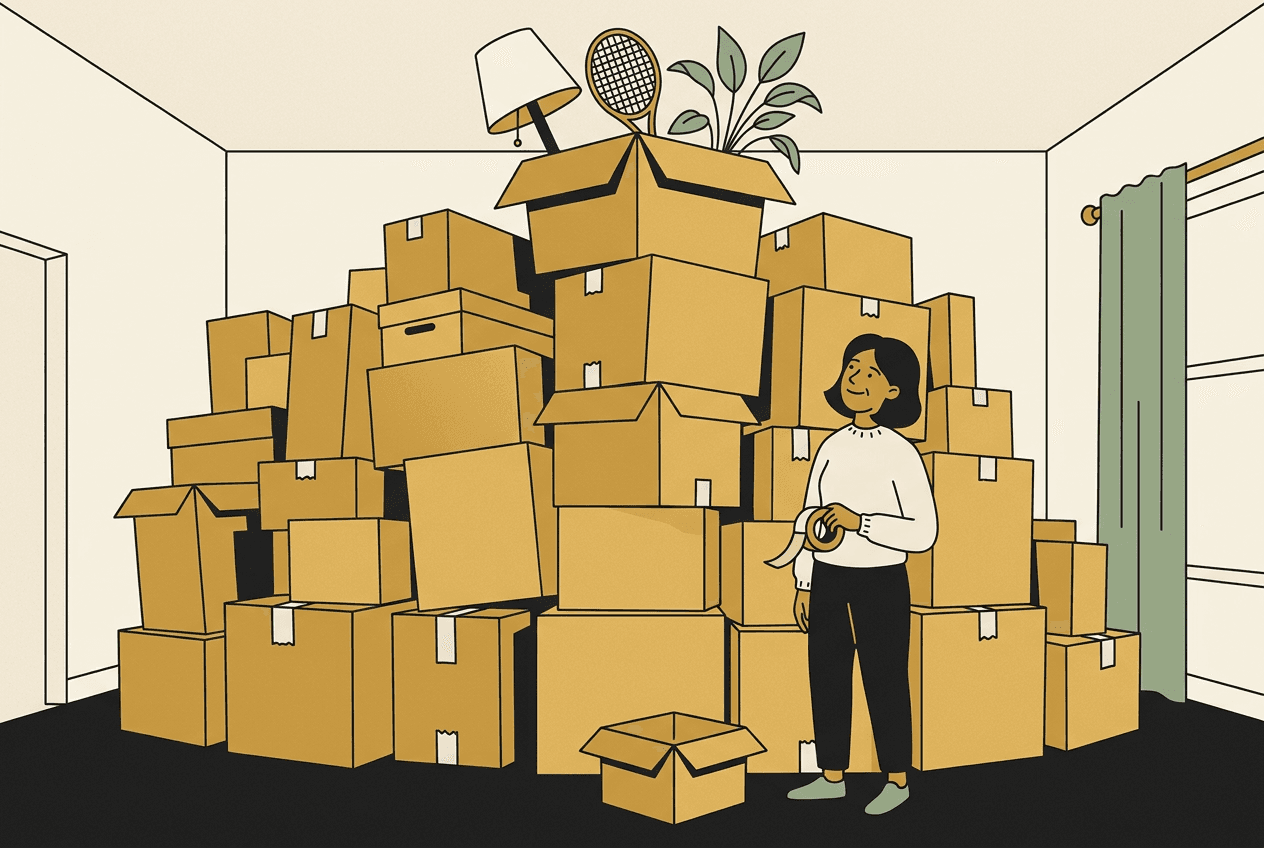
You have a spare room. Somewhere along the way it stopped being a spare room and became the place things go when someone is coming over.
It starts small. A bag of things you meant to sort. Then the folding chairs. Then the box from your last move that never got fully unpacked. Then guests are arriving in two hours, the kitchen counter has to be clear, and all of it lands in there and the door shuts.
I have opened a lot of those doors. Nobody should feel bad about it. It is one of the most common rooms I get called about in Kelowna, and it is almost never messy people. It is people whose things have nowhere else to live.
The room is doing exactly what you trained it to do
Most spare room organization advice tells you to buy bins, sort into keep and toss, and build a system in that room. That skips the actual problem.
The things in your spare room are in there because they have no home anywhere else in the house. The winter coats that do not fit the front closet. The paperwork that never made it to the office. The gift wrap, the extra bedding, the kids' old things you are not ready to decide about. None of it belongs in the spare room. It belongs somewhere else, and that somewhere is already full.
So if you organize the spare room on its own, you build a very tidy holding pen. The next time guests come, the counter clears into it again, and you are back where you started inside a month. I have watched that exact cycle in homes across Kelowna and West Kelowna, usually with the receipts for the bins still in a drawer.
The room is a symptom. The real issue is that half of what is in it was never given a home in the first place.
Why it always gets worse before a visit
There is a reason this room fills on a schedule rather than gradually.
When people are coming, you need the public rooms clear in a hurry. Kitchen counter, dining table, living room floor. Under that kind of time pressure nobody makes decisions about objects, they make decisions about surfaces. Everything goes somewhere out of sight, and the spare room is the only door in the house that closes on a mess without anyone seeing it.
That is not a character flaw. That is a reasonable response to having forty minutes and a doorbell.
What it does mean is that the spare room is now storing two completely different things at once. The stuff that has no home, and the stuff that does have a home but got swept in during a rush. Those two piles need opposite treatment, and treating them the same is why the room never resolves.
Where the work actually happens
When I take on a spare room, we do not start by tidying the spare room. We start by pulling everything out into categories on the hallway floor or the bed in the next room. Bedding here. Paperwork there. Sentimental in its own pile, deliberately, so it does not slow the rest down. Anything that belongs to another room gets a pile pointed at that room.
Then the honest part. For each category we decide where it lives. Not where it landed. Where it lives.
The extra bedding usually belongs in the closet of the room it gets used in, not two doors away. The paperwork needs a real spot in a working home office setup, which sometimes means a filing box on a shelf and nothing more elaborate than that. The gift wrap wants one container in one place, because gift wrap multiplies quietly when it is stored in three locations and nobody can remember which.
Some of it, once you see it all in one place, turns out to be something you have been storing for years and do not want. That group is always bigger than people expect, and seeing it in a single pile is what makes it obvious.
The part of a spare room that is worth money
This is where a spare room surprises people, and it happens on nearly every one of these jobs.
Furniture that came with you from a previous house and never got used here. A box of kitchen gear that duplicates what is already in the drawers. Sporting equipment nobody has touched in four years, which is usually the overflow from a garage that stopped fitting a car a few years earlier. Small appliances still in the packaging, because they were a gift and there was no counter space for them. Baby gear, once the babies are eleven.
A lot of that has real resale value. During a sort I flag it, price it with you, and list it right from your home, usually on Facebook Marketplace. Your items never leave the house until there is a confirmed buyer, and you handle the final handoff and take the payment directly. You keep 60 percent of every sale.
What that changes, practically, is the emotional maths of the room. Letting go of a bassinet that cost four hundred dollars feels different when it goes to a family in Lake Country who needed one and you have the money in your account that afternoon. Same object, same decision, completely different feeling about making it.
What the room looks like when the work is done
Once every category has a true home, the spare room empties out on its own. There is no clever storage solution at the end of this. The room just stops having a job it was never meant to have.
What is left is the small amount of things that genuinely belong in that room. A guest bed you can see the whole of. A dresser with two empty drawers, which is the detail guests actually notice, because it means they can unpack. Maybe a chair.
The door tends to stay open after that, and it stays open for a mechanical reason rather than a motivational one. The counter no longer has anywhere to disappear to. When there is a rush before company, things go back to where they live, because now they have somewhere to live and putting them there is the path of least resistance.
That is the whole trick, and it is not much of a trick. Make the right thing the easy thing.
It is also why I am wary of spare room organization that starts and ends with containers. Containers are the last five percent of the job. They are useful once a category has a home and a known volume, and they are expensive furniture for indecision before that. Buy them at the end, when you know exactly what is going in them and exactly where it is going to sit.
The pile that belongs to somebody who moved out
In a good number of these rooms there is a stack of boxes that are not yours at all. They belong to a son or a daughter who moved into a rental with no storage, or moved to Vancouver, or moved in with a partner and left the childhood things behind.
Nobody brings this up unprompted. It sits there for years because raising it feels like telling your own child they are not welcome, which is not what it is.
The way through it is a date and an offer. You tell them the room is being sorted on a particular weekend, and you offer to box their things properly and store them somewhere specific in the meantime, or to send photographs so they can decide from where they live. Both of those are generous. Leaving the question open for six years is the option that quietly costs everyone a room.
What you should not do is decide for them. I have seen that go badly enough times to say it plainly. Photograph, box, label, and put the decision in front of the person whose things they are.
One category, this week
Pick one category, not the whole room. Bedding is a good one to start with because it is bulky, unemotional, and the decision is fast. Paperwork also works if you are the kind of person who would rather get the worst one over with.
Take just that one type of thing out of the spare room and decide where in the house it should live. Put it there properly. Do not touch anything else in the room, even if you want to, because the point of the exercise is to prove the principle to yourself rather than to finish.
You will feel the difference straight away, and you will start to see how much of that room is things that belong elsewhere versus things you are simply done with.
If the spare room is filling up because you are getting ready to move somewhere smaller, that is a different job with a deadline attached, and I do that work too through right-sizing support.
When you want the whole room handled in one go, without making every decision alone, that is what I am for. The consultation is free, I will walk through it with you at your pace, and there is no judgement in it anywhere. I got you.